Saturday, 22 May 2010


Wednesday, 19 May 2010
9 Foods That Reduce Stress Levels
Reach for these items next time you're feeling under pressure, under the weather, or just too close to that breaking point. Munching on these stress-free foods will help pull you back into the game.
Oranges
A German study in Psychopharmacology found that vitamin C helps reduce stress and return blood pressure and cortisol to normal levels after a stressful situation. Vitamin C is also well-known for boosting your immune system.
Sweet potatoes
Sweet potatoes can be particularly stress-reducing because they can satisfy the urge you get for carbohydrates and sweets when you are under a great deal of stress. They are packed full of beta-carotene and other vitamins, and the fiber helps your body process the carbohydrates in a slow and steady manner.
Dried apricots
Apricots are rich in magnesium, which is a stress-buster and a natural muscle relaxant as well.
Almonds, pistachios and walnuts
Almonds are packed with B and E vitamins, which help boost your immune system, and walnuts and pistachios help lower blood pressure.
Turkey
Turkey contains an amino acid called L-tryptophan. This amino acid triggers the release of serotonin, which is a feel-good brain chemical. This is the reason why many people who eat turkey feel relaxed, or even tired, after eating it. L-Tryptophan has a documented calming effect.
Spinach
A deficiency in magnesium can cause migraine headaches and a feeling of fatigue. One cup of spinach provides 40 percent of your daily needs for magnesium.
Salmon
Diets high in omega-3 fatty acids protect against heart disease. A study from Diabetes & Metabolism found that omega-3s keep the stress hormones cortisol and adrenaline from peaking.
Avocados
The monounsaturated fats and potassium in avocados help lower blood pressure. The National Heart, Lung, and Blood Institute says that one of the best ways to lower blood pressure is to consume enough potassium (avocados have more than bananas).
Green vegetables
Broccoli, kale, and other dark green vegetables are powerhouses of vitamins that help replenish our bodies in times of stress.
More stress-busting tips:
Exercise reguarly.
Eat small meals throughout the day, which will keep your blood sugar stable (when blood sugar is low, mental, physical, and emotional energy decreases, and stress increases).
Sunday, 16 May 2010
3 Fat Loss Nutrition Tips to Blast Fat

I was in the shop looking for some magazines when something caught my eye. The subtitle read Hot Bodies Best Diets. I can't remember exactly which magazine featured the subtitle but it was one of the popular tabloids. I had two questions immediately.
What do they mean by "Hot Bodies"?
What do they mean by "Best Diets"?
According to the magazine "Hot Bodies" means skinny and "Best Diets" means diets that make you skinny. I looked through the magazine and I found that celebrities use all kinds of different diets just like non-celebrities. There was a common factor with all the diets in the magazine, calorie deficit. A diet that results in calorie deficit does not necessarily mean a quality diet, but it does mean weight loss. In my opinion all quality diets share some characteristics.
The key factors in quality diets are:
Calorie intake (matters whether you're consciously counting or not).
Consumption of sufficient quantity of essential nutrients.
Consideration of individual likes and dislikes.
Consideration of metabolic abnormalities.
Occasional breaks from the diet.
Recognizing that you don't have to stick to the program 100% of the time to see the benefits.
1. Junk Food
Does consuming junk food (highly processed foods) make you fat? That depends on how much junk food you eat and your average daily metabolic rate. Isn't junk food bad for your health? That depends on how much junk food you eat, your energy expenditure and whether you have any metabolic abnormalities.
2. Do Calorie Sources Matter If A Calorie Is A Calorie?
A calorie is a unit of energy. It is the amount of energy or heat that it takes to raise the temperature of one gram of water one degree Celsius (1.8 degrees Fahrenheit). The energy derived from foods when they are oxidized in the body is measured in kilocalories (thousands of calories).
A kilocalorie is the amount of energy required to raise 1000 grams of water one degree Celsius. Kilocalorie is written as "Calorie" (with a capital C) or it may be abbreviated to "Kcalorie" or "Kcal." Therefore, whenever the word calorie is used in connection with food or nutrition, the meaning is always kilocalorie or calorie.
In terms of fat loss, a low calorie diet consisting of crisps will result in weight loss just like a low calorie diet consisting of fruits and vegetables. When considering which is more nutritious, fruits and vegetables wins hands down. Which is more filling? Fruits and vegetables win again. When considering issues other than energy content it's not just about calories.
We get calories from four sources including protein (4 Kcal per gram), fat (9 Kcal per gram), carbohydrate (4 Kcal per gram) and alcohol (7 Kcal per gram).
Are all calories the same? Yes and No.
Technically speaking a calorie is a calorie. The definition of a calorie does not change, but different calorie sources have different properties, and they affect the body in various ways. So, when considering nutrient value, affects on appetite, intolerances, and allergies, there are differences in calorie sources.
On a final note, some low-carb advocates claim that calories from fat are different than calories from carbohydrate. This assumption comes from the fact that short term weight loss is usually greater, even when eating the same amount of calories, with a low carbohydrate diet than a higher carbohydrate diet; however this occurs due to water loss.
3. Supplements
Do you really need to spend hundreds of pounds per month on supplements if your nutritional practices are optimal? I doubt it. Let me re-word that, no, you don't.
Supplements add to the program. They do not replace sound training and nutrition. Legendary protein researcher, Kevin Tipton, says, "There is no reason to recommend protein supplements per se because there is no evidence that supplements work better than foods." I am not anti-supplement, but I am anti-nonsense.
Thursday, 13 May 2010
Coming Soon..... The Pound for Pound Diet Plan

The Pound for Pound Diet Plan is like no other !
There are no membership fees !
1-2-1 training sessions in our private studio are available at no extra charge, regardless of the number of sessions you require !
A bespoke service tailored to the individual !
Food plans are created for your use at no extra cost !
and much more.....
Further details to be announced soon.......
Monday, 10 May 2010

Are you considering taking part in the Standard Chartered Jersey Marathon this year?
Whether you are attempting to take-on the gruelling 26 mile course or are joining a relay team, 1-2-1 Fitness can help you with your training.
From exercise plans to 1-2-1 training sessions, we are able to assist you every step of the way.
If this is your first time running in the event, we will prepare you for the challenge.
If you are a regular runner, we will help you increase your pace and overall fitness.
For further information, call 1-2-1 Fitness on 07700 335 973
or send us an e-mail to onetoonefitness@hotmail.co.uk
Sunday, 9 May 2010
How The Bodybuilding Supplement Whey Can Help You Drop Body Fat

Sleep, genetics, your training program, what you eat and stress all play a role in how your body looks and how you feel. If you've made changes to what, when and how much you eat as well as your training program but you still can't seem to drop that stubborn body fat, consider how the bodybuilding supplement whey protein may help.
What Is Whey Protein?
Whey protein is a milk protein that is the liquid by-product of cheese production. In supplement form, whey protein comes in three main forms:
Whey Protein Concentrate: Contains some fat and lactose and between 29% - 89% protein depending on the specific product. Whey protein concentrates often have more bioactive compounds.
Whey Protein Isolates: Contains minimal fat, cholesterol and lactose and 90% or more protein.
Whey Protein Hydrolysates: Are often used in clinical nutrition applications because they are predigested and partially broken and therefore easier to absorb.
Whey protein has the highest protein digestibility corrected amino acid score (PDCAA) - a measure of both how well a protein is digested and how well it supplies the amino acids needed by an adult. In addition, it is a complete protein meaning it contains all essential amino acids.
Whey also contains more branched chain amino acids (BCAAs) than any other source of protein and more leucine than other types of protein.
Several studies indicate that whey protein is beneficial for increasing muscle protein synthesis. Consume whey post-training and you'll tip the scale in favour of muscle growth and strength gains over time. But, there are a number of other benefits associated with whey protein.
How Bodybuilding Supplement Whey Protein Can Help You Shed Body Fat:
Add whey and drop weight? It sounds too good to be true but it may work.
Whey Protein Is Rich in Leucine: Leucine plays a key role in protein synthesis, a process that burns through quite a few calories. In addition, it stimulates fatty acid oxidation.
Whey Satiates Your Appetite: Studies show that whey may satiate your appetite better than some other types of protein. Milk proteins contain glycomacropeptide - a peptide that stimulates the cholecystokinin (CCK). CCK is an intestinal hormone that is released after eating a meal and it signals satiety.
Studies Show Supplemental Whey Helps People Drop Body Fat: There are at least two studies where scientists examined whey protein supplementation and weight loss. In one study at the University of Oklahoma, scientists told both groups of participants not to change their diet. However, one group was given a nutrition supplement containing whey (300 calories, 40 grams of protein) once per day for two weeks and twice a day for the remaining eight weeks of the study. Both groups engaged in a supervised resistance and endurance-training program for 10 weeks.
After the 10-week study, both groups decreased fat mass but the exercise + food supplement group showed a significantly greater decrease in fat mass (-9.3% versus -4.6% in the exercise-only group). The supplemented group also showed significant gains from pre- to post-test in muscle mass and significant decreases in total and LDL cholesterol.
A 2006 study found that adding 60 grams of whey protein per day, in comparison to 60 grams of soy protein or 60 grams of carbohydrate, led to significant decreases in body fat and weight after 6 months.
Additional Tips To Help Shed Body Fat:
Use a food journal and write down everything you eat. Studies show that people who log their food intake every day are more likely to lose weight than those who do not.
Seek the advice of a sports nutrition expert to help you.
If you are having problems losing weight yet you feel you are doing everything right, talk to your physician. Low levels of certain hormones, hypothyroidism and other conditions can make weight loss more difficult.
Conclusion:
If you want to shed body fat, it makes prudent sense to incorporate whey protein into your routine. As a bodybuilder, this is something you should already be doing. After all, why spend time in the gym trying to get a better body (health and physique) if you aren't going to eat the right foods to support the changes you are striving for? Try whey, if nothing else, you'll likely notice an increase in strength.
Thursday, 6 May 2010
Quick and Easy Pea and Ham Soup
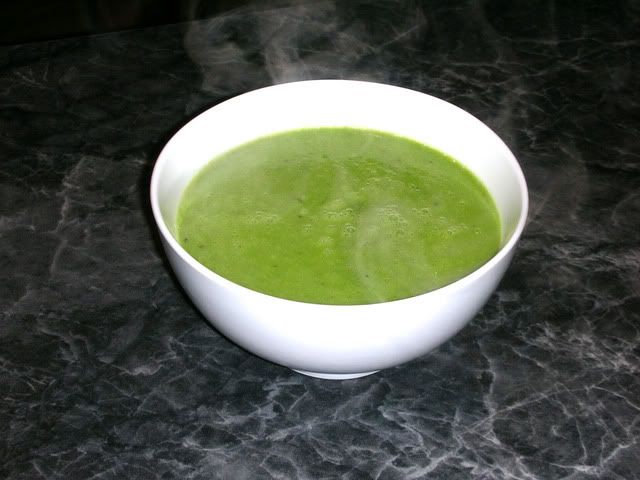
This recipe is so easy, I thought it was worth mentioning it here...
I was looking for something to snack on the other day so decided to make a soup.
I looked through the cupboards and nothing appealed to me. I then thought "I know, I will make a soup".
Within 10 minutes I had created a wonderful and healthy soup packed full of vitamins, protein and fibre.
Here is how it was made....
Chop 2 spring onions into a pan and gently fry in olive oil.
Once softened, add frozen peas to the pan (the amount depends on how many you are cooking for so you be the judge).
As soon as the peas are defrosted, add enough water to just cover the peas. Add a ham stock cube also (add 2 cubes if cooking for 2 people).
Stir until the stock cubes have dissolved.
Break 2 bay leaves into the soup (without stalks) and heat for 10 minutes.
Add pepper and then blend until smooth.
Serve and enjoy.
Stir in a spoon of yogurt if you want to be naughty...
Subscribe to:
Posts (Atom)

 Posts
Posts


