Thursday, 6 May 2010

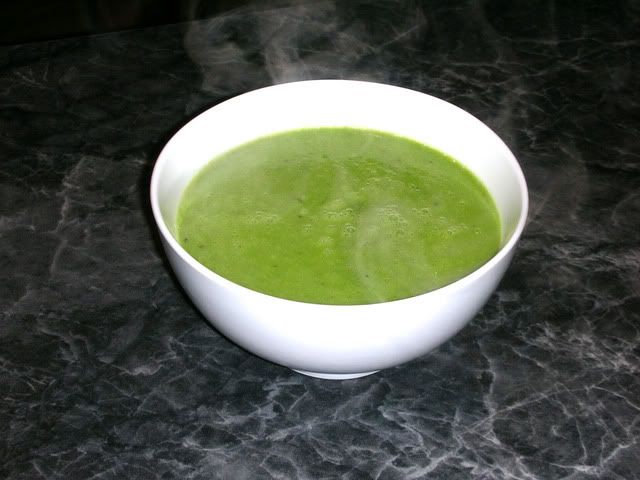
Quick and Easy Pea and Ham Soup


This recipe is so easy, I thought it was worth mentioning it here...

I was looking for something to snack on the other day so decided to make a soup.

I looked through the cupboards and nothing appealed to me. I then thought "I know, I will make a soup".

Within 10 minutes I had created a wonderful and healthy soup packed full of vitamins, protein and fibre.

Here is how it was made....


Chop 2 spring onions into a pan and gently fry in olive oil.

Once softened, add frozen peas to the pan (the amount depends on how many you are cooking for so you be the judge).

As soon as the peas are defrosted, add enough water to just cover the peas. Add a ham stock cube also (add 2 cubes if cooking for 2 people).

Stir until the stock cubes have dissolved.

Break 2 bay leaves into the soup (without stalks) and heat for 10 minutes.

Add pepper and then blend until smooth.

Serve and enjoy.

Stir in a spoon of yogurt if you want to be naughty...

Friday, 30 April 2010

3 Key Factors for Fat Loss – Part 3


Key #3:
Exercise


You will lose fat by dieting alone, but not as effectively as you would using a calorie controlled diet and exercise plan. If you just dieted, you would end up as a smaller version of yourself.

Exercise helps you to build muscle (which helps you to burn more calories and lose more fat in the process), as well as helping you feel good about yourself, and providing a way to destress. The FITT and SOAP principles should be applied to your exercise program.

The FIIT principle:

Frequency: The number of training sessions completed in a given time period.

Intensity: The level of exertion that you are training at - i.e. if you are training for basic strength you will be using 80-90% of your one repetition maximum.

Time: How long the session lasts for - i.e. resistance training should last no longer than 45-50 minutes.

Type: What mode of exercise is being performed - i.e. aerobic, anaerobic, strength, power, etc.

The SOAP principle:

Specificity: Training you in a manner specific to producing the training adaptation or goal achievement desired - i.e. you must be training for fat loss. "Specificity also relates to the athlete's sport season. As an athlete progresses through the pre-season, in-season, and postseason, all forms of training should gradually progress in an organized manner from generalized to sport specific" - i.e. if you are an athlete your off-season would be general conditioning, progressing to strength and power work, then speed, and eventually to sports specific exercises. "The more similar the training activity is to the sport movement, the greater the likelihood that there will be a positive transfer to that sport".

Overload: "Refers to assigning a workout or training regime of greater intensity than the athlete is accustomed to. Without the stimulus of overload, even an otherwise well-designed program greatly limits the athlete's ability to make improvements. Overload training principles ensure that the muscles involved in the selected exercises are those that the sport relies on and that the loads are sufficient to challenge the athlete to become stronger, larger, faster, and more resistant to fatigue" - i.e. if you are training for strength, then if you do not consistently increase weights lifted during resistance training, then you are not overloading the muscles enough to get stronger. It is only when the body is consistently pushed that gains are made.

Adaptation: Training must be continually progressing via overload; otherwise [positive] adaptations can be lost quickly and performance can begin to decline, with fitness and conditioning sometimes returning to its initial state - i.e. if there was no periodization to your training and you perpetually did the same thing, then your body would stop making adaptations and progressing.

Progression: "The intensity of the training must become progressively greater. Progression, when applied properly, promotes long-term training benefits" - i.e. this is why you must change your training program every 4-6 weeks, to ensure that you are providing new challenges and continually getting results.

The best exercise program for losing fat is one that includes weights, cardio (mostly in the form of high intensity training), and flexibility (to help your muscle flexibility and joints).

Resistance Training:

If you are a beginner, you can start off with 2-3 full-body workouts each week. Otherwise, I would recommend a 3 or 4 day split. Each muscle group should be rested for at least 1 day before training that muscle group again. This gives it plenty of time to recover before the next training session.

Exercises that you should be doing are multijoint, compound exercises, as they use more than one muscle, and are the most effective for not only building muscle, but also in burning fat, because they are recruiting more of your body to perform the exercise than isolation exercises (these are a waste of time unless you are a seasoned lifter and are looking to target specific muscle groups).

The best compound exercises that you can do are the squat and the deadlift, as they use pretty much every muscle in your body. Other compound exercises that are good to include are the bench press, shoulder press, pullups, dips, and calf raises (the only isolation exercise that's really good).

You should be performing between 25-40 repetitions per muscle group, consisting of 3 sets of 10 repetitions for example per exercise, with a 1 minute recovery in between the sets (the shorter the recovery, the lighter your weights will possibly be, which will give you a 'cardio' workout as well).

Be sure that you always use good form for every exercise; otherwise you are putting yourself at risk for injury. All reps should be controlled and with good form. It is not about how much you can lift, but how well you lift. You will get stronger as you keep at it (although maybe not so much when trying to lose fat, but this depends on the individual).

You should never spend longer than 45-50 minutes in total lifting (i.e. your session should take that long from the time you walk in to the time you walk out, excluding if you do a warm-up - and this is strictly your own preference); otherwise you become too catabolic and can end up losing muscle.

You also need to change your weights program around slightly every 4-6 weeks, just so that your body does not get used to it and stop adapting. This can be as little as changing the order of exercises in a session or the number of sets and/or reps that you do for an exercise (and it only needs to be one exercise changed at a time, small adjustments over the weeks).

Here's a sample circuit plan for a beginner. This is a very basic routine, designed to get you 'used' to resistance training and condition your body for it, building a base to work on, whilst also targeting your goals. After 4-6 weeks you will need to change your program.

Do an easy 10 minute warm-up. Select weights that you can do for said reps on each exercise (but not too much more), and use these for the entire session.

Complete exercises in order from 1-7, with minimal recovery (ideally it should be moving from one exercise to another; but if you are a beginner 30-60 seconds will be ok). At the end of one set (i.e. 1-10) rest for 1 minute, and then repeat. Stretch full-body for 5 minutes after your session. This should take ~45 minutes in total.

Every week your weights should increase (i.e. not on all sessions, but keep weights the same for a week, and increase as you can for the next week's sessions), so that you keep challenging your body.

Beginner Fat Loss Workout Program:

Barbell Squats: 2 sets of 15 reps
Romanian Deadlifts: 2 sets of 15 reps
Standing Calf Raises: 2 sets of 15 reps
Pullups: 2 sets to failure
Pushups: 2 sets to failure
Dumbbell Shoulder Press: 2 sets of 15 reps
Crunches: 2 sets to failure

I highly recommend getting a personal trainer if you are a beginner, so that you can be shown the correct technique (very important) for each exercise.

Personal trainers can be there with you for your first few sessions, to determine starting weights, as you get acquainted with resistance training. They also provide motivation, support, and a source for accountability.

A personal trainer will also assist in creating a workout for you and should offer nutrition advice.

Cardio

Whilst long, slow cardio burns calories, you require long periods of time to do it. Some even recommend doing two hours of cardio a day, or double cardio sessions, to lose fat, but it's simply not necessary.

The most effective way to burn fat through cardio is to do either:

Interval training

Cardio at a higher intensity (i.e. just going out and running as fast as you can over a certain distance, instead of 45 minutes at a 60% max heart rate).

Forget about the 'Fat Burning Zone'; it does not matter what fuel you use during cardio, as your body will burn other substrates during the rest of the day (i.e. if you burn fat during cardio it will use carbs the rest of the day, and vice versa).

If you feel that you need to do more cardio, then you can do brisk walks every other day, or perhaps a run (but no more than 30 minutes; after 30 minutes of running you are very catabolic and are likely to lose muscle, which you do not want happening). Skipping, stair sprinting/running, or rowing, are the next highest calorie burners after sprinting.

Flexibility:

Stretch for 10-20 minutes per day, preferably after you have done either cardio or weights, while your muscles are still warm, as this decreases the risk of injury. Stretching makes sure that you can move more freely and easily and helps elongate the muscles, ligaments, and tendons.

Remember that when it comes to exercise more is not always best!

You want maximal results for minimal time. You also need to remember that some of this is experimental, and about finding what works best for you, since everyone is different and responds differently to different exercise programs.

Conclusion

The first step to successful fat loss is to set a goal. Your goal should follow the principles of SMART goal-setting. Once you have set your goal, then you need to look at your nutrition.

Your diet should be individualised for you, to ensure that you get the results that you want in the timeframe that you want them. Your diet should follow the principles of adequacy, balance, energy control, nutrient density, moderation, and variety.

The last piece of the fat loss puzzle is exercise. Your exercise program should follow the FITT and SOAP principles; and include resistance training (3-4 times weekly), cardio (predominantly in the form of high intensity sessions), and flexibility (to aid your joints and muscles).

As long as you are eating right for you for fat loss, doing weights 3-4 times per week, doing cardio 2-3 or more times per week for 12-30 minutes per day (depending on the intensity; the higher the intensity the shorter you do it for!), and allowing your body to recover (this is very important; if you do too much, then your body will not be able to recover properly and you will not get the results you want, since your body only adapts and gets results in the recovery time!), then you will successfully lose fat!

1-2-1 Fitness can help you start your journey to a leaner, fitter body.

Please contact me for further information.
Tuesday, 27 April 2010

3 Key Factors for Fat Loss – Part 2


Key #2:
Nutrition


When you look at your nutrition you should think "diet", as defined by a diet plan that can only be sustained for short periods of time (i.e. low calorie or low carbohydrate diets). When you think "diet", you should think lifestyle eating (i.e. your diet should be something that you can easily maintain all year round, with the only thing you change about it being the amount of calories consumed, based upon your body goal).

Your diet plan should incorporate 6 principles:

Adequacy: Your diet provides enough energy and nutrients to meet your needs.

Balance: Not over consuming any single type of food.

Energy Control: You need to know what your energy needs are (i.e. maintenance), and allow for that; to ensure that you get the nutrients that you require without going in excess of your required calories, use foods that have a high nutrient density.

Nutrient Density: Select foods that deliver the most nutrients for the least energy.

Moderation: Moderating portion sizes; and consuming foods that contain high fat and sugar in moderation.

Variety: Eating a variety of foods day-to-day.

Here are some tips on diet for fat loss:

Eat every 2-3 hours after waking. This helps keep the metabolism going throughout the day, as well as keeping insulin levels stable (you can see that 3 meals is simply not enough, even if they are in small portions).

Every meal should include quality lean protein (i.e. chicken breast, fish, tuna, salmon, lean beef, egg whites, etc.), and fibrous carbs (i.e. vegetables, green ones in particular). Complex carbohydrates (i.e. rice, oats, etc.), should be consumed mainly around your workouts.

Do not avoid fat (except saturated fat and trans fats). You need fat in your diet, as fat plays major roles in energy metabolism and other parts of your body. It is important to ensure that you consume your required amount of good fats (i.e. flaxseeds or flaxseed oil, fish oils, peanut butter, nuts - especially almonds and walnuts, hempseed oil, olive oil, etc.) each day.

Do not avoid carbs completely. You need a small amount of carbs each day for your body to burn fat effectively and to provide the energy requirements of your brain and central nervous system.

The only sugar needed on a regular basis is the natural sugar found in food; these are mostly found in fruit. Too much sugar plays havoc with insulin levels; you want these as stable as possible throughout the day. The best time to be having sugar is straight after a resistance workout, when the body is trying to replenish muscle glycogen stores. Therefore, make sure that you have a protein shake with some simple sugar (i.e. fruit smoothie with ice and protein powder is great here) as soon as possible after your resistance training, and then a proper meal (i.e. complex carbs, protein, fibrous carbs) about 60 minutes after your post-workout shake.

Consume adequate protein, to prevent muscle loss and maintain a relatively high thermic effect.

It has been proven that one or two servings of dairy per day help you lose more fat than if you avoid it altogether.

At a minimum your body requires 2 litres of water per day to cover its water needs. For those with higher energy outputs, good recommendation is to drink 4 litres of water per day. This will help keep your system clean.

Do not drink black tea or coffee. Try drinking green tea instead; it helps with thermogenesis, and is especially good if you take it one hour before doing cardio first thing in the morning.

Do not drink alcohol. Alcohol has no nutritional value and is full of calories.

Minimize salt addition to food. Instead, flavour meals with herbs and spices (i.e. ginger, cumin, cayenne pepper, curry powder, chilli powder, and garlic all help thermogenesis).

Eat most food as 'natural' as possible. This means fresh fruit and vegetables, meat, grains, etc. Try not to eat too much packaged food, as it is full of extra calories and sugar.


Most importantly, remember that it is OK to cheat every now and then. Actually the body needs cheat meals. By throwing all the guidelines just mentioned out of the way and having a day where you eat what you want it helps not only your mind, but also in preventing your body from going into starvation mode (i.e. where the body battles you to hold onto the fat as much as it can). If you prefer not to 'cheat', then add in 1-2 higher calorie days (i.e. go up to just above maintenance, or bulking, or even slightly higher), with the extra calories coming from quality complex carbs.

Supplements should not be a big deal, as most fat loss can be done through simply eating the right food at the right time; and unless everything that you are doing is already done to ensure the maximum results in the timeframe that you want to achieve it in, and then supplementation should not be the focus. However, there are a few supplements that I think are important to any regime.

Multivitamin: Although you should be eating as much of a variety of food as possible, in order to meet the RDI/AI of most nutrients from actual food.

Creatine Monohydrate: Creatine helps the body to recover faster, as well as indirectly aiding in increasing strength levels and lean body mass.

Flaxseed/Fish Oil: This is the good fats. Flaxseed or Hempseed oil is great with breakfast or in protein shakes.

Protein Powder: This just helps when you are struggling to fit a meal in, or after the gym, and to make sure that you get enough protein in.
Apart from these four 'staple' supplements, you do not need much else. You especially do not need fat-burners or thermogenics; they are a waste of time unless you are already lean and are looking for that 'extra edge' to lose the extra % BF (i.e. like a fitness competitor, etc.)

The 1-2-1 Fitness Diet is available at a very competitive rate. We will calculate your daily nutrient requirements for you, help you with meal plans and assist you all the way until you reach your goal.

Please contact me if you would like more information regarding the 1-2-1 Fitness Diet.


Part 3 of this article will be coming soon....

Monday, 26 April 2010

3 Key Factors for Fat Loss – Part 1


Many people have the desire to lose weight. More specifically, many people desire to lose body fat . However, most of those people do not know how to go about it. They see conflicting messages everywhere, from one fad diet to another, one person telling them one thing about training and someone else telling them differently.

Those who are successful at fat loss know their body well and how it responds to different aspects of nutrition and training manipulation. Those who do not know look to those who are successful and try to emulate their methods. What everyone needs to remember is that everything is individual. What works for one person may not work for another.

However, there are three keys to fat loss that apply to everyone:

1. Goal Setting
2. Nutrition
3. Exercise


Each key is important, and without one of those keys, whilst one may lose weight/bodyfat for a time, they are less likely to keep that weight/bodyfat off.

This article is going to discuss the first key, and make suggestions on how to utilize them effectively for fat loss.


Key #1:
Goal Setting


The first thing that you need to do, before you look at diet and exercise, is to set goals. Look at where you are now, and what you want to be. Your end goal can be whatever you want, because as long as you give yourself a realistic timeframe to achieve it in, you can achieve anything that you want!

Once you have set your long-term goal, then you need to set smaller goals - these are your short-term goals that will help you get to your long-term goal. Goals made should be SMART goals.

Specific: You must be specific in what your goals is - i.e. I want to lose 4% bodyfat in 8 weeks.

Measurable: You must be able to measure your progress towards achieving your goal - i.e. %bodyfat can be measured doing a 6-8 skinfold body composition test every week.

Adjustable: Your goals must be able to be adjusted if for whatever reason something happens and they no longer become realistic for the period that you have set yourself.

Realistic: Your goals must be realistic - i.e. losing 4% bodyfat in 8 weeks is realistic; losing 4% bodyfat in 2 weeks is NOT.

Time-Based: You must set a time frame over which you want to achieve your goal; have specific start and finish dates- i.e. I want to lose 4% bodyfat in the period 13 July to 6 September.


Part 2 (Nutrition) will be posted soon, so keep your eyes peeled for it....

Thursday, 22 April 2010

Using a Foam Roller ? You should be !


A decade ago, strength coaches and athletic trainers would have looked quizzically at a 36-inch long cylindrical piece of foam and wondered, "What is that for?" Today, nearly every athletic training room and most strength and conditioning facilities contain an array of foam rollers of different lengths and consistencies.

What happened to bring foam rollers into prominence? The change has been in our attitude toward massage therapy. We have been slowly moving away from an injury care mode of isokinetics and electronics to more European-inspired processes that focus on hands-on soft tissue care. We now realize that techniques like massage, Muscle Activation (MAT), and Active Release Therapy (ART) can work wonders for sore or injured athlete.

In addition, the understanding at the elite athlete level is: If you want to stay healthy, get a good manual therapist in your corner. Thus, athletes at all levels are starting to ask for some form of soft tissue care.

What does all this have to do with foam rollers? As coaches and athletic trainers watched elite-level athletes experience success from various soft tissue techniques, the obvious question arose: How can I make massage available to large groups of athletes at a reasonable cost? Enter the foam roller.

National Academy of Sports Medicine President Michael Clark, DPT, MS, PT, NASM-PES, is credited by many-this author included-with exposing the sports medicine community to the foam roller. In one of Clarke's early manuals, he included a few photos of self-myofascial release using a foam roller. The technique illustrated was simple and self-explanatory: Get a foam roller and use your bodyweight to apply pressure to sore spots.

Since then, many of us have discovered more uses for foam rollers, including injury prevention and performance enhancement. We've also moved away from the accupressure concept and now use them more for self-massage. And we've come up with specific protocols for different situations.

Essentially, foam rollers are the poor man's massage therapist. They provide soft tissue work to the masses in any setting. But you need to know their nuances to get the most out of them.


What, How & When

A foam roller is simply a cylindrical piece of extruded hard-celled foam. Think swimming pool noodles, but a little more dense and larger in diameter. They usually come in one-foot or three-foot lengths. I find the three-foot model works better, but it obviously takes up more space.

They are also now available in a number of densities from relatively soft foam (slightly harder than a pool noodle), to newer high-density rollers that feel much more solid. The denser the athlete, the more dense the roller should be. Large, heavily-muscled athletes will do better with a very high density roller whereas a smaller, younger athlete should begin with a less dense product.

The application techniques are simple. Clarke's initial recommendation was based on an accupressure concept, in which pressure is placed on specific surfaces of the body. Athletes were instructed to use the roller to apply pressure to sensitive areas in their muscles-sometimes called trigger points, knots, or areas of increased muscle density. The idea was to allow athletes to apply pressure to injury-prone areas themselves.

The use of foam rollers has progressed in many circles from an accupressure approach to self-massage, which I've found to be more effective. The roller is now usually used to apply longer more sweeping strokes to the long muscle groups like the calves, adductors, and quadriceps, and small directed force to areas like the TFL, hip rotators, and glute medius.

Athletes are instructed to use the roller to search for tender areas or trigger points and to roll these areas to decrease density and over-activity of the muscle. With a little direction on where to look, most athletes easily find the tender spots on their own. However, they may need some instruction on the positioning of the roller, such as parallel, perpendicular, or 45 degrees, depending on the muscle.

The feel of the roller and intensity of the self-massage should be properly geared to the age, comfort, and fitness level of the athlete. This is one of the plusses of having the athlete roll themselves-they can control the intensity with their own body weight.

There is no universal agreement on when to roll, how often to roll, or how long to roll, but generally, techniques are used both before and after a workout. Foam rolling prior to a workout can help decrease muscle density and promote a better warmup. Rolling after a workout may help muscles recover from strenuous exercise.

My preference is to have athletes use the rollers before every workout. We also use them after a workout if athletes are sore.

One of the nice things about using the foam roller is that it can be done on a daily basis. In fact, in their book, The Trigger Point Therapy Workbook, Clair Davies and Amber Davies recommend trigger point work up to 12 times a day in situations of acute pain.

How long an athlete rolls is also determined on a case-by-case basis. I usually allow five to 10 minutes for soft tissue activation work at the beginning of the session prior to warmup. If my athletes roll after their workout, it is done for the same length of time.


Some Specifics

While the foam roller can be used on almost any area of the body, I have found it works best on the lower extremities. There is not as much dense tissue in the upper body and our athletes are not prone to the same frequency of upper body strains as lower. The hamstrings and hip flexors seem to experience the most muscle strains, so we concentrate on those areas.

Here are some protocols I use:

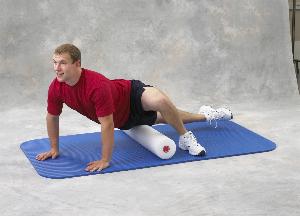
Gluteus max and hip rotators: The athlete sits on the roller with a slight tilt and moves from the iliac crest to the hip joint to address the glute max. To address the hip rotators, the affected leg is crossed to place the hip rotator group in an elongated position. As a general rule of thumb, 10 slow rolls are done in each position (although there are no hard and fast rules for reps). Often athletes are simply encouraged to roll until the pain disappears.

TFL and Gluteus Medius: The tensor fasciae latae and gluteus medius, though small in size, are significant factors in anterior knee pain. To address the TFL, the athlete begins with the body prone and the edge of the roller placed over the TFL, just below the iliac crest

After working the TFL, the athlete turns 90 degrees to a side position (see Figure Three on page XX) and rolls from the hip joint to the iliac crest to address the gluteus medius.

Adductors: The adductors are probably the most neglected area of the lower body. A great deal of time and energy is focused on the quadriceps and hamstring groups and very little attention is paid to the adductors. There are two methods to roll the adductors. The first is a floor-based technique that works well for beginners. The user abducts the leg over the roller and places the roller at about a 60-degree angle to the leg. The rolling action begins just above the knee in the area of the vastus medialis and pes anserine, and should be done in three portions. To start, 10 short rolls are done covering about one third the length of the femur. Next, the roller is moved to the mid-point of the adductor group and again rolled 10 times in the middle third of the muscle. Last, the roller is positioned high into the groin almost to the pubic symphysis for a final set of 10 rolls.

The second technique for the adductors should be used after the athlete is comfortable with the first one. This exercise requires the athlete to sit on a training room table or the top of a plyometric box, which allows him or her to shift significantly more weight onto the roller and work deeper into the large adductor triangle. The athlete then performs the same rolling movements mentioned above.

Although I primarily use the rollers for athletes' legs, they can also be used with upper extremities. The same techniques can be used for pecs, lats, and rotator cuffs, although with a much smaller amplitude-making the movements closer to accupressure.


Assessing Effectiveness

Foam rolling is hard work that can even border on being painful. Good massage work, and correspondingly good self-massage work, may be uncomfortable, much like stretching. Therefore, it is important that athletes learn to distinguish between a moderate level of discomfort related to working a trigger point and a discomfort that can lead to injury.

When an athlete has completed foam rolling, he or she should feel better, not worse. And the rollers should never cause bruising. Ask the athlete how his or her muscles feel after each session to assess if the techniques are working.

I also judge whether foam rolling is working by monitoring compliance. If I don't have to tell athletes to get out the foam roller before a workout, I know the techniques are working. Most do it without prompting as they see the benefits.


Rolling vs. Massage

The question often arises: "Which is better, massage therapy or a foam roller?" To me the answer is obvious: Hands-on work is better than foam. Hands are directly connected to the brain and can feel. A foam roller cannot feel. If cost was not an issue I would have a team of massage therapists on call for my athletes at all times.

However, having an abundance of massage therapists on staff is not in most of our budgets. Therein lies the beauty of the foam rollers: They provide unlimited self-massage for around £20. Sounds like a solution to me.

Tuesday, 20 April 2010

Antioxidants: Twenty Of The Best Health-Boosting Foods


The US Department of Agriculture recently presented a Top 20 list, which provides a surprisingly helpful guide for picking out some of the healthiest foods the next time you go to the supermarket. (I say 'surprisingly' because these are the same people that brought us that famous food pyramid that was built on refined flour.)


Measuring up
Last month, a team of USDA nutritionists published a study in the Journal of Agricultural and Food Chemistry. The title: 'Lipophilic and hydrophilic antioxidant capacities of common foods in the United States.'

Snappy title. But perhaps a more descriptive title would be 'Top 20 antioxidant-rich foods.'

The USDA nutritionists examined more than 100 different kinds of fruits, vegetables, nuts, spices, cereals and other foods. Using an analysis method called the oxygen radical absorbance capacity (ORAC), they were able to detect the lipid soluble (lipophilic) and water soluble (hydrophilic) antioxidant capacities of the food samples.

They also singled out certain foods to test the impact from two different processing methods: cooking and peeling.

Starting at the bottom...

The results weren't altogether surprising: Fruits, vegetables and beans claimed nearly all the spots in the Top 20. We'll start with the lower ten, counting backwards:

20. Gala apples
19. Plums
18. Black beans (dried)
17. Russet potatoes (cooked)
16. Black plums
15. Sweet cherries
14. Pecans
13. Granny Smith apples
12. Red delicious apples
11. Strawberries

If there's a surprise here, it's that strawberries - known for their high antioxidant content - just missed the top ten.

Cream of the crop....

When I began reading the USDA study, I tried to guess the number one antioxidant food before looking at the list. I guessed 'blueberries,' and I was close, but not quite on the money. Here's the Top 10:

10. Raspberries
9. Prunes
8. Blackberries
7. Artichokes (cooked)
6. Cranberries
5. Blueberries (cultivated)
4. Pinto beans
3. Red kidney beans
2. Blueberries (wild)

And the number one antioxidant-rich food:

1. Small red beans (dried)

Small red beans! Who knew? The small red bean looks like a kidney bean - same colour and shape - except that it's (you guessed it) smaller. It's sometimes identified as a Mexican red bean, but it's grown in Washington, Idaho, and Alberta, Canada.


To cook, or not to cook...
The USDA list is very useful, but it's important to remember that the best way to get your antioxidants is not to eat heaping bowls of dried small red beans each day, but rather to eat a wide variety of antioxidant-rich foods.

That way you'll also get other useful nutrients, such as ellagitannin; a substance that has been shown to help prevent the growth of cancerous cells and is found in raspberries and strawberries. And when you eat pecans you'll add copper and potassium to your diet.

Pinto and kidney beans are good sources of folate (sometimes called vitamin B-9), which may help lower homocysteine levels. And blueberries deliver a chemical called anthocyanis that has been shown to help protect brain cells.

As you might imagine, most antioxidant foods lose some of their antioxidant capacities in processing. (The most notable exception is the tomato; the antioxidant lycopene is enhanced by cooking.) Ronald L. Prior (one of the study co-authors) told HealthDayNews that 'fresh' is the unsurprising best choice over frozen, cooked or otherwise processed.

So while blueberry pie may seem like a somewhat healthy treat, it can't begin to compare with a bowl of blueberries, picked fresh from the meadow.

Friday, 16 April 2010

The Basics Of Bulking And Adding Lean Mass


While most of us are always trying to lose weight, there are some people who are interested in just bulking up; which in simple terms means eating more and training heavier in order to gain muscle weight.

There could be many reasons for this such as, a person has been dieting for a long period of time and wishes to increase size and muscle tone.

Or, a sports person that includes a vast amount of cardiovascular exercise into their routine and has suffered muscle atrophy.

Like everything, there is a right way and a wrong way to do things. I see many people who in an attempt to gain weight just start eating everything in sight, and thus, either overtax their digestive systems, thus not being able to eat several times a day, and/or simply start gaining too much body fat, as the case is for those without a hardgainer metabolism.

In order to gain quality weight, the nutrients taken in have to be of a high quality nature. While some hardgainers have such a fast metabolism that they could benefit from also adding cheat meals to their nutrition plan, the best way to gain weight is through a planned and controlled increase in macronutrient intake. By ensuring that the quality of the nutrients is high (such as low glycemic index carbohydrates, low fat proteins and high quality fats) muscle weight gain is optimized and fat weight is minimized.

However, in order for a bulk up phase to be effective, it needs to be executed properly. Otherwise, you end up gaining way too much body fat, which at the end of the day, whether you just want to look good for the beach over the summer or participate at a bodybuilding competition, you will need to lose anyways. In this bulk up/weight gain guide I'll teach you the bulking up rules to gaining some solid muscle weight while minimizing fat gains.


When To Bulk Up
First of all, bulking up is not about eating everything in sight and trying to lift as heavy as possible hoping that all of the increased weight gain will come in the form of muscle. This old school strategy will only lead to excessive fat gain. The best time, in my opinion, to bulk up is after you have been dieting for a long period of time. At this time your body will act like a sponge and absorb all of the nutrients that you give it at peak efficiency in response to the fact that it has not been getting such an influx of nutrients for a while. Also, if you are above 10% body fat, in which case you cannot see your abs, then you need to concentrate on losing body fat up until the point (at the very least) where you can see the top two rows of abs (when you have a four pack). Your bulk up plan will work even better, however, if you get down to where you can easily see your full abdominal wall (which is around 6-7% body fat for most people) as when you increase calories in this state, your body will be more primed to gain most of the weight in the form of muscle mass in response to the low calorie period that came before it.


Bulking Up Basics
Having said that, know that while most of the weight that you will gain will be in the form of muscle, some of it will be in the form of fat no matter how good your diet is. The reason for that is the fact that on a state of caloric surplus (when you feed your body more calories than what is burned) some of those calories are stored as body fat. However, by bulking up on good foods, by training hard and by starting from a low percentage of body fat, you will minimize the fat gain and maximize the muscle mass gain.